A Billion Dollar Portfolio Gone
This one isn't a New England investor, but the story is so intriguing I had to include it.
For anyone who's been following, the Chetrit Group — one branch of the New York real estate dynasty — has been fending off creditors on multiple assets over the last few years. A deposition of Meyer Chetrit, taken April 28 of this year, was recently made public, and it brings to light a level of detail that had not been visible before.
It's a public court filing. Search NYSCEF as a guest for New York County index 655162/2024 and open Doc. No. 143 — no login, no fee:
iapps.courts.state.ny.us/nyscef
The most striking part of the saga isn't the fact that a high profile investor is in distress. It's the fact that it's only 1-3 bad deals which are wiping out a 35 year run from one of the most storied players in the business.
This isn't a story about recklessness or a gambler. We're talking about one of the brothers of a dynastic family which had collectively accumulated billions of dollars of equity and survived multiple downturns over a long career. Reconstructing his own schedule of real estate (admittedly loose and incomplete) puts his personal equity at its peak somewhere around $300–400M. Asked in the deposition what everything he still holds an interest in is worth, his answer was: minus 18 million.
Two numbers matter in everything below. The first is equity — what he put in and lost. The second is exposure beyond equity — the judgments that survive after the equity is gone, because he signed personally.
The Damage, Deal by Deal
Deal |
Acquired |
Capital Stack at Entry |
Where It Stands (2026) |
Meyer's Equity Lost |
Exposure Beyond Equity |
255 W 34th St |
2014 |
Site assembled 2014; construction financed by Arbor, broke ground 2019 |
Surrendered to Maverick Jan 2023 at a stated $104.5M |
$20–50M |
~$150M judgment |
Hotel Carter |
2014–15 |
$192M price; $129M acquisition loan; $175M family cash in over time |
Debt $150–160M vs. the $103M value he gave on the record; sheriff's auction pending |
$57.4M |
$31M in judgments |
Tides Hotel, Miami Bch |
n/a |
$42M mortgage |
Judgment fixed at $95.6M Jan 2026; auctioned Mar 2026 on a $10,300 credit bid |
— |
$95.6M judgment |
ROCO apartments |
Jun 2019 |
$481M JPMorgan loan at 84% LTV, floating at LIBOR + 498 bps — ~7.4% all-in at closing |
Maturity default Jul 2022 at a ~7.3% coupon — no refinancing available; auctions from 2024 |
$25–75M |
Wells Fargo guaranty suit pending |
Midwest portfolio (~4,000 units) |
n/a |
Not stated |
Keys handed back the afternoon of the deposition |
~$25M |
Sole guarantor; Joseph is not |
Reem Acra (fire) |
n/a |
Operating liability, not a deal |
Judgment entered |
— |
$39M judgment |
Miami River |
n/a |
Madison Realty Capital; JV with Adam Neumann's side; Chetrits held 42–50% |
Not in foreclosure. He transferred his interest to the partner for, by his testimony, a high five |
His ownership interest, given up for zero |
None |
26 Broadway |
2007 |
$225M + $34.8M leasehold; refinanced 2022 to $330M |
Special servicing; DSCR 0.76x |
~$0 — they had already pulled their basis out |
None |
TOTAL — Meyer's personal position |
$103–157M of equity gone |
$316M+ of judgments on top |
|||
Sources: Meyer Chetrit deposition, April 28, 2026 (NYSCEF Doc. 143, N.Y. County Index 655162/2024); public court filings and reporting in The Real Deal, Crain's, and Bisnow. Where a figure is a range, the deposition did not state a number and it is estimated from surrounding facts. 26 Broadway is the control: same sponsor, same cycle, same rate shock, no personal exposure — because no guaranty reached him.
How Three Deals Metastasized
You need to follow the chronology of these deals to get a proper sense of the setup. What I’m struck by, is that it was decisions made years ago, dating back as far as 2014-2015 which are coming back to haunt him.
These three deals did not go wrong at three different times. They were set up in a five-year window, sat quietly for years producing nothing, and then all came due inside the same eighteen months.
2013–2016: peak liquidity, and where it went
This is the top of their run. The Sony Building was bought for $1.1B in 2013 and sold for $1.4B in 2016. Willis Tower, bought for $840M in 2004, went to Blackstone for $1.3B in 2015. Enormous realized gains, back to back.
In the same window they deployed into two positions that would produce no income for the next decade: the 255 West 34th site in 2014, and Hotel Carter for $192M in 2014–15 against a $129M loan. Both were bets on a future exit market rather than on cash flow. Neither was wrong on the real estate. Both required someone else to be buying, later, at a price nobody could yet see. Both were vulnerable to the market dynamic that emerged post covid.
2018–2019: the debt goes up, the third bet goes on
Four years after buying Carter, still closed and unrenovated, they refinanced it into a $152M JPMorgan bridge. The debt rose $23M and the building was no closer to opening. This is the first tell — a refinancing that funds carry rather than construction.
Then 2019 does everything at once. In June they buy the ROCO apartment portfolio for roughly $573M on a $481M JPMorgan loan at 84% LTV, floating at LIBOR plus 498, personally guaranteed. That same year, five years after acquiring the site, they finally break ground at 255 West 34th.
At the end of 2019 the position is: one hotel closed for five years, one hotel under construction, and 8,671 apartments at 84% leverage on a floating rate. Three illiquid positions, all massive in size, none of them stabilized, all of them dependent on the same two things — cheap refinancing and a functioning exit market.
2020–2021: the windfall nobody used
COVID stalls 255 West 34th at the 23rd floor. Carter stays dark. And LIBOR collapses — which means the most dangerous position in the portfolio, the floating-rate apartment loan, briefly becomes the cheapest debt they have.
It is worth walking the actual rate path on that loan.
Moment |
1-Month LIBOR |
All-In (L + 498) |
Annual Debt Service on $481M |
What It Meant |
Closing — June 2019 |
~2.40% |
~7.4% |
~$35.5M |
The underwritten cost |
COVID trough — 2021 |
~0.08% |
~5.1% |
~$24.4M |
~$11M/yr below underwriting |
Maturity default — July 2022 |
~2.35% |
~7.3% |
~$35M |
Back to the entry coupon |
Peak — mid-2023 |
5.18–5.5% |
~10.2% |
~$49M |
The refinancing rate that did not exist |
LIBOR figures: 2019 range from ICE historical series (year high 2.52%, year low 1.69%, first Fed cut July 31); 0.09% at June 30, 2021 per SEC filing disclosure; 5.18% average for the quarter ending June 30, 2023 per U.S. Dept. of Education, the last quarter LIBOR was used. The July 2022 figure is estimated off a 2.25–2.50% Fed funds target. A LIBOR floor, if the loan carried one, would have capped the 2021 benefit at roughly 5.5% all-in.
At origination they were paying roughly 7.4% all-in — about $35.5M a year on $481M, interest-only. By 2021 that had fallen to roughly $24.4M. They were handed an eleven million dollar a year windfall.
And that is precisely the window in which 8,671 units sat at 76% occupancy, against a 95% national average, in the strongest leasing market in living memory. The operating failure did not happen under rate pressure. It happened while they had the massive tailwind of artificially low COVID rates.
2022: everything comes due in nine months
April — the 255 West 34th loans mature. May — Maverick buys roughly $110M of that debt. July — the ROCO portfolio hits maturity default. August — they refinance Carter again, this time with a Mack facility structured as a $120.5M first mortgage plus a $31.5M mezzanine, taking the debt to roughly $150M on a building that has now been closed for eight years. November — a $100M paydown on ROCO (fresh equity injection), plus twelve assets under contract, in an effort to save it.
That $100M is the moment worth studying. It's the reserve, deployed at exactly the right time, into the right deal. It bought a few months. The reserve would have worked, but the issue is that their cash reserves were not sized property to the portfolio and the total amount of outstanding debt. Plus, everything was personally guaranteed creating contamination exposure. And the trifecta was that the same market change was creating issues simultaneously at Carter, at 255 West 34th, and at 26 Broadway, two of which were non cash flow generating stalled development sites with huge carry costs.
December 31, 2022 is the date on the last personal financial statement he ever produced. Five weeks later, 255 West 34th is gone.
2023–2026: the compounding phase
Once the equity is gone, the judgments take over and they grow faster than anything he can earn. The clearest illustration is the Tides Hotel in Miami Beach: $42M of unpaid mortgage debt became a $95.6M judgment over roughly five years through default interest and fees, and in March 2026 the hotel cleared at auction on a $10,300 credit bid — leaving essentially the entire balance as a personal deficiency.
Meanwhile the bench disappears. Jacob (Meyer’s brother) dies in January 2025. Joseph is hospitalized that April after two strokes, and has a hip replacement in February with a complication requiring a second surgery. The workout negotiating — which by this time has become the day to day business— falls to one man in his sixties, not against a relationship bank, but against debt funds.
The Three Deals, Precisely
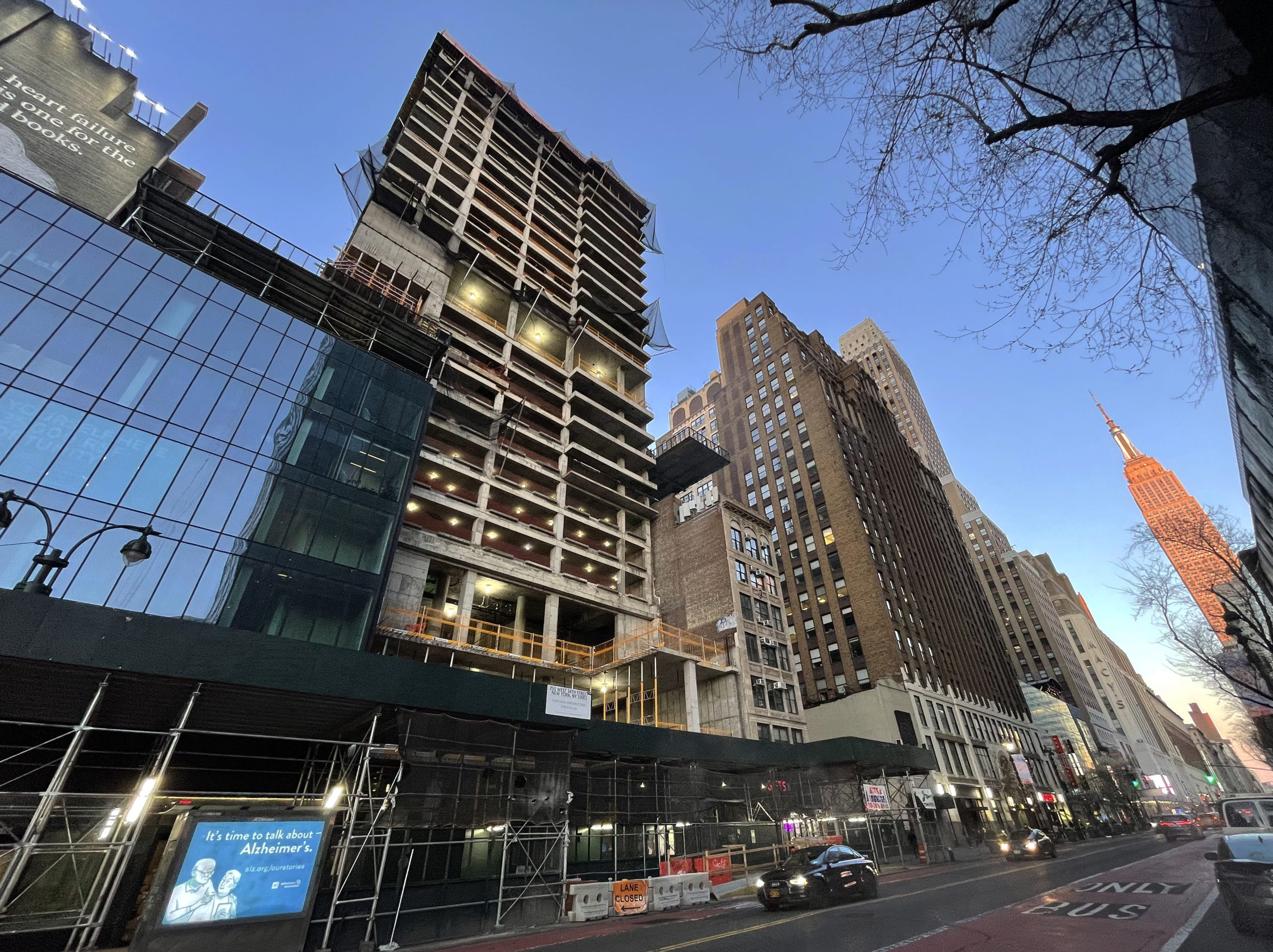
255 West 34th Street
Site assembled 2014, ground broken 2019 on a 33-story, 323-key hotel financed by Arbor. COVID stalled it at the 23rd floor. By his own lawsuit it needed another $46M to finish; Maverick put the figure at $106.4M. The loans matured April 2022; Maverick bought roughly $110M of the debt in May, granted one extension to October 30, and — per Maverick — received no payments.
Chetrit transferred the project on January 31, 2023 at a stated $104.5M, then sued claiming Maverick had run off other bidders and taken the property on a $100,000 credit bid. Maverick finished the building; it topped out in July 2025.
Equity: $20–50M contributed, entirely gone.
Exposure beyond equity: $132M deficiency judgment, now roughly $150M with interest — and Maverick has been enforcing it by garnishing and auctioning his LLC interests in other properties.
Hotel Carter
Bought for $192M in 2014–15 against a $129M acquisition loan. Chetrit testified the three brothers put in $175M of cash across the life of the deal, his share 40%, or $57.4M. They closed the hotel and never renovated it. Eleven years of no income, funded by refinancings that raised the debt — $129M, a $152M JPMorgan bridge in 2018, a Mack facility in 2022 — without adding value.
Asked what the property is worth today, he said $103M. Asked what his own equity is worth: less than zero. The debt is $150–160M. Deferred maintenance became its own liability: the City sued over more than 150 violations carrying penalties of at least $1,000 a day each.
Equity: $57.4M of his own cash, gone in full — plus $117.6M more from Joe and Jake.
Exposure beyond equity: $24M judgment in October 2025 and $7M in a related case, on the mezzanine guaranty. The building is headed to an all-cash sheriff's auction.
The ROCO Apartment Portfolio
June 2019, a national apartment portfolio bought from Roco Real Estate, financed with a $481M JPMorgan loan at 84% LTV, floating at LIBOR plus 498 bps. Meyer personally guaranteed it.
In the deposition he describes it as twelve thousand apartments in "middle America," recalls the lender as Citibank, and says he, Joe, and Jake had $75M of cash in it and lost all of it. Asked whether there was a foreclosure, he said he didn't know how it happened, only that they lost them. The loan documents put the portfolio at 8,671 units across ten states. A $100M paydown in November 2022 and twelve assets under contract did not hold; properties began going to foreclosure auction in 2024. Wells Fargo has since sued JPMorgan alleging the loan was underwritten on inflated NOI.
Equity: Roughly $92M of portfolio equity at closing, plus the $100M paydown.
Exposure beyond equity: He is the personal guarantor on the $481M loan. Wells Fargo's suit against him on those guaranties is pending, and unquantified.
The Full Schedule
His statement of financial condition carried roughly thirty positions. Counsel walked him down the list line by line and asked which he still had an interest in. This is that walkthrough.
Line Item on the Schedule |
His Answer, April 2026 |
Carried Value (12/31/22) |
Note |
Park West Village |
Still has it |
$20,866,000 |
"Ask him if he can get me one dollar" |
500 / 512 Seventh Ave |
Still — but the bank takes it for less than a dollar |
— |
AIG foreclosure; Chetrit Group is the non-paying tenant |
900 / 100 Trinity |
Still has it |
— |
|
65 Broadway |
Still has it |
— |
|
44 West 63rd |
In foreclosure |
— |
He had to ask counsel for the word 'foreclosure' |
One Executive Drive |
Gone |
— |
|
Two Executive Drive |
Gone |
— |
|
227 East 19th |
Gone |
— |
|
37 (unspecified) |
"Belongs to Mac" |
— |
Taken by the creditor deposing him |
98 Montague |
The bank has it |
— |
|
735 Columbus |
Still has it |
— |
|
Miami River |
Still has it |
— |
Interest transferred for, by his testimony, a high five |
Collins Park |
Still has it |
— |
|
176 Pennington |
"Bye bye" |
— |
|
199 Pennington |
Doesn't have it |
— |
|
200 East 79th |
Still has it |
— |
|
86-88 |
Still has it |
$66,520,000 |
Paired with Park West: $87.4M carried, nothing extractable |
Hotel Carter |
"Bye bye… it's theirs" |
$57,400,000 (his 40%) |
"They can have it today, if they want" |
7050 Queens Boulevard |
Still has it |
— |
Interests later garnished and auctioned to Maverick |
6411 |
"Bye bye" |
— |
|
383 South Center |
"Bye bye" |
— |
|
1612 |
Still has it |
— |
|
122-09 |
In the bank |
— |
|
6806 Milbrook Park Drive |
No answer given |
— |
|
1726 Reisterstown Road |
No answer given |
— |
|
260 East 72nd |
Still has it |
— |
|
14402 Hillside Ave |
"Wrong" — owns 33%, worth ~$6M |
$49,350,000 |
Offers at $21–22M for 100%. The only line tested against a real bid. |
7037 Madison Pike |
Cannot identify it |
— |
Profanity in the transcript |
26 Broadway |
"0, I don't have it" |
— |
Special servicing |
Voyage Way |
Cannot identify it |
— |
Profanity in the transcript |
3077 Madison Pike |
Cannot identify it |
— |
"I don't know what address is this" |
15009 88th Ave |
The bank has it |
$87,500,000 |
"If the bank gives me 20 million, I dance on Fifth Avenue naked" |
Four line items he could not identify at all. Two more he did not answer. On his own financial statement.
The Lessons
Personal Guarantee Exposure
The issue isn't that he had a guarantee on a bad deal. It's that he handed them out habitually and never kept a running tally of his aggregate exposure.
The deposition is explicit. Asked whether he was the borrower or guarantor on any personal or business loans, he answered no. Pressed, he said not that he knew. Reminded of the case he was sitting in, he said: this is not personal. Asked once more, he conceded he has many loans — fifteen to twenty. Asked whether he had any document showing all of the deals in which he is a borrower or guarantor, he answered no.
He was not being evasive there. The number had never been maintained anywhere, so he genuinely did not know it.
The $300–400M was his peak, and the guaranties were signed against that peak — a balance sheet that no longer exists. Equity fell to negative eighteen million. The guaranties did not fall at all. They are fixed obligations being enforced against a destroyed balance sheet, and they compound at statutory interest while he has no income.
If any meaningful share of that peak equity had been converted into cash reserves, or held in an asset outside the guaranteed entities, he would be negotiating settlements right now instead of sitting for a debtor's exam. The guaranty stack is only fatal because there is nothing on the other side of it.
Equity: $300–400M at peak.
Exposure beyond equity: $316M+ of entered judgments, enforceable for twenty years and renewable.
Development Risk, Ballooning Carry, Magnified Losses
Hotel Carter did not fail on a price crash. It failed on the interest clock and a changed interest rate regime that nobody imagined — not at acquisition in 2014, and not at any of the subsequent refinancing rounds. Eleven years of zero income, three financings that each raised the debt rather than lowering it, and a value that finally came in $50M below the loan balance.
They never developed it. The plan was a gut renovation and it was never executed. The equity wasn't consumed by construction overruns — it was consumed by carrying a dead asset while the debt compounded, and by the violations that pile up on a building nobody is maintaining.
Each round raised the debt without adding value, which means each round was underwriting the same asset at a higher basis on the strength of a lower discount rate.
Equity: $175M of family cash, of which $57.4M was his. Zero recovery — the debt exceeds the value by $50M+.
Exposure beyond equity: $31M of judgments on the guaranty, entirely separate from the lost equity.
Who Holds Your Note Matters — and What Happens When Their Interests Are Opposite Yours
One lesson we've all seen this cycle: relationship lenders were generally agreeable and extended, while debt funds enforced terms. 255 West 34th is the clean case. The loans matured in April 2022 and Maverick bought them in May — after the default, not before. A lender who wants to be repaid grants an extension and takes a fee. A fund whose business model is acquiring defaulted paper takes the asset, because taking the asset is the trade.
Maverick bought roughly $110M of debt on a stalled hotel and then demanded Chetrit either complete the building or hand over the $106.4M it would cost to finish it — a demand structured to be unmeetable by a borrower who had already said he couldn't raise $46M. When the property was surrendered, Chetrit's suit alleges Maverick ran off other bidders and took it on a $100,000 credit bid. Maverick then finished the building itself.
A city marshal garnished Meyer's membership interests in a series of LLCs and sold them at auction — and at the December sale, the only two bidders in the room were his brother Juda and a representative of Maverick, with Maverick paying $1M for entities tied to a Woodside development site.
A relationship lender is long your survival, because your survival is how they get repaid. A distressed debt fund is short it. Every month you spend not paying accrues default interest that increases their claim, and every asset you can't refinance becomes something they can take at a credit bid. There is no version of "waiting them out."
Chetrit's entire playbook was extend, renegotiate, outlast. It worked for three decades and stopped working the month his loan changed hands. Asked at the deposition what caused his position, he named the two lenders. Asked whether it was the market, he said no. Asked about interest rates, he said a little bit — but nothing compared to those two. Asked whether he understood they were not his partners and owed him nothing, he said yes: but still, they stop you from breathing.
The practical takeaway is that your underwriting has to include a question almost nobody asks: who could plausibly own this paper at maturity, and how do they make money? That's not paranoia. It's the single variable that decided this outcome.
Equity: Unchanged by who held the note — the equity was gone either way.
Exposure beyond equity: This is where the note-holder shows up. A relationship lender's workout ends at a deed in lieu. Maverick's ended in a $150M judgment, garnished LLC interests, and a fraud claim.
Interest Rate Exposure Magnified to the Extreme
The 2019 apartment portfolio was bought at 84% LTV on floating-rate debt priced at LIBOR plus 498. At 84% leverage, equity is 16% of the stack — a 16% move takes all of it, and there is no cushion for anything else.
At closing in June 2019, 1-month LIBOR was around 2.40%, putting them at roughly 7.4% all-in. At maturity default in July 2022, LIBOR was around 2.35% — roughly 7.3% all-in. Basically what it was when they went into the deal.
They did not default because debt service rose. They defaulted because a loan came due and no refinancing existed.
That is the real lesson of high leverage in a repricing market. By mid-2023 the level of interest rates on that structure was headed north of 10%. At 84% LTV, there is no version of that refinancing that works — not at a lower proceeds level, not with a cash-in paydown (at least with the shortfall of reserves the borrower had in this case). A conservatively levered owner in the same buildings refinances at a smaller loan and moves on. A borrower at 84% has no room to write the check that closes the gap, so the maturity itself is the default event.
Between 2020 and 2021, LIBOR fell to roughly 0.08% and their all-in cost dropped to about 5.1% — some $11M a year below what they underwrote. That was the window to fix occupancy, sell assets into a hot market, and de-lever ahead of the maturity. Instead the portfolio ran at 76% occupancy through March 2022, and the $100M paydown did not come until November 2022, four months after the default.
Nothing about those buildings changed between 2019 and 2023. What changed was the price at which anyone would refinance them.
Equity: ~$92M of equity at closing plus a $100M paydown — all of it subordinate to a loan that was 84% of the stack.
Exposure beyond equity: Full recourse. Wells Fargo's guaranty suit against him on those guaranties is pending; the eventual number is not yet fixed.
Spread Too Thin
The other problem with that portfolio was that its size, scale, and geographic dispersion made it very hard to manage. 8,671 units across ten states ran at 76% occupancy in the twelve months through March 2022 — against a 95% national average, in one of the best residential leasing environments in memory.
That is not a rate story or a market story. It's a span-of-control story. A well-run portfolio at 90% survives the rate shock that killed one at 76%. Worth noting the firm was running eight to ten closings a year out of a small office with a skeleton staff — an acquisition engine with no asset-management engine behind it.
Equity: The occupancy gap alone represents roughly 1,650 vacant units of NOI that would have covered debt service.
Exposure beyond equity: None directly — but it is why the guaranty was ever called. Operations are what buy you the room to negotiate.
Reserves + Fenced Recourse = Optionality
The sharpest contrast is inside the family. In December, an affiliate of the Chetrit Organization — the other branch of the family — bought roughly $40M of defaulted debt on a SoHo building it already owns, from a loan originally over $60M. When your own paper trades at a discount, you buy it and retire your debt at a fraction of face.
It's fair to ask why nobody did that for Meyer — if it were that simple, surely a brother steps in and buys the paper rather than letting Maverick have it. Three reasons, and each one is a lesson of its own.
First, a brother did show up. At the December auction of Meyer's garnished LLC interests, the only two bidders in the room were Juda Chetrit and a Maverick representative. The family did try. It wasn't enough.
Second, and most important, Meyer had already had personal judgements awarded against him to the tune of hundreds of millions of dollars. You don’t inject another $50M into a property to save it, when the judgement holder can essentially just come take it away from you after the fact. Even if the family had the capability to step in and rescue him, they’d be throwing good money after bad, and it wouldn’t be enough to bail out the entire portfolio.
Third, the branches had split in 2011 and Jacob's side was carrying its own problems — 850 Third went to its lender in 2023, and 1 Whitehall and 428 Broadway have both been hit with foreclosure notices. Jacob died in January 2025. Joseph had two strokes. There was no fresh balance sheet standing by.
Equity: Peak equity of $300–400M, none of it retained in liquid or unencumbered form.
Exposure beyond equity: $316M+ in judgments, with no capacity to settle or to buy his own paper at a discount.
The Takeaway
His schedule of real estate ran roughly thirty positions. Three bad deals destroyed all thirty. 35 years of work.
A 10% deal-level failure rate produced a 100% portfolio loss — and that arithmetic is only possible because of recourse. Without the guaranties, three bad deals out of thirty costs you three deals. The other twenty-seven keep paying, and you're a guy who had a rough cycle.
It’s also the result of concentrating equity into highly leveraged positions, and into large scale development deals years away from income. Even with the recourse, if it had been just 255 West 34th St, and material cash in reserves or equity in low leveraged cash flowing assets, this probably wouldn’t have gotten to the level it did.
The Thirty-Five Year Tailwind
There is a version of this story where Chetrit is simply a bad operator who finally got caught. That version doesn’t survive contact with the record. He came through 1998, 2001, 2008 and COVID. Somewhere in there, something was working.
Every one of those crises was cured by the same medicine: cheaper money. Fed funds sat around 8% when the brothers started buying in the early 1990s. The 2001 recession was met by cuts from 6.5% down to 1%. 2008 was met with zero and quantitative easing. So was 2020. Across the entire 35-year arc of this family’s career, the direction of travel on interest rates was down, and every crisis accelerated it.
Rate cuts are not neutral relief. They are specifically medicine for a leveraged owner. They refinance your maturities, inflate the value of what you already own, and hand you years to grow into a basis you overpaid for. Chetrit didn’t just survive 2008 — he was paid handsomely for having survived it. And the lesson it taught was that leverage plus patience works.
Why this cycle is different
2022 was not that kind of crisis.
A credit crisis is cured by cheap money. An inflation shock is cured by expensive money. There is no rate-cut rescue for a problem caused by rate increases. The exact lever that rescued every leveraged owner in 2009 is the lever that broke them in 2023 — and a playbook built entirely on the first situation had never once been tested against the second.
That is why the 2008 survival was not evidence of skill so much as evidence of a position — and why it was actively dangerous.
Nothing about the present environment suggests the old medicine is coming back soon. The Fed has held at 3.50–3.75% for five consecutive meetings; three members dissented in July preferring a hike; futures have moved from pricing cuts to pricing the possibility of increases by year end. Anyone underwriting a refinancing bailout right now is underwriting a hope.
What it means when cap rate compression stops paying
For 35 years you could be wrong about the asset, wrong about the tenant, and years late on the business plan, and cap rate compression would still cover you. That is over, and possibly running in reverse. At a constant NOI, every year of cap rate expansion takes value out of the building whether or not you do anything wrong.
Which leaves four sources of return, all of which have to be earned rather than granted: the basis you buy at, the NOI you actually grow, the principal you amortize, and inflation quietly eroding fixed-rate debt you were smart enough to lock long.
And it flips the one variable that mattered most to how Chetrit operated. In a falling-rate world, time was the sponsor’s ally — hold long enough and the market bails you out. That is the assumption underneath holding a closed hotel for eleven years. In this regime, time is roughly neutral if you own cash flow with amortizing debt, and it is lethal if you own something that doesn’t produce income. Carter and 255 West 34th produced nothing for a decade between them. The buildings were fine. The carry killed them.
